
Author: Natalie Foley
The landscape of leadership development has undergone a significant transformation over the past decade. As organisations become increasingly complex and fast-moving, traditional, top-down performance management systems are no longer sufficient to drive growth.
Today, effective leadership growth requires multi-dimensional insight — and this is where the 360 survey becomes a powerful development tool.
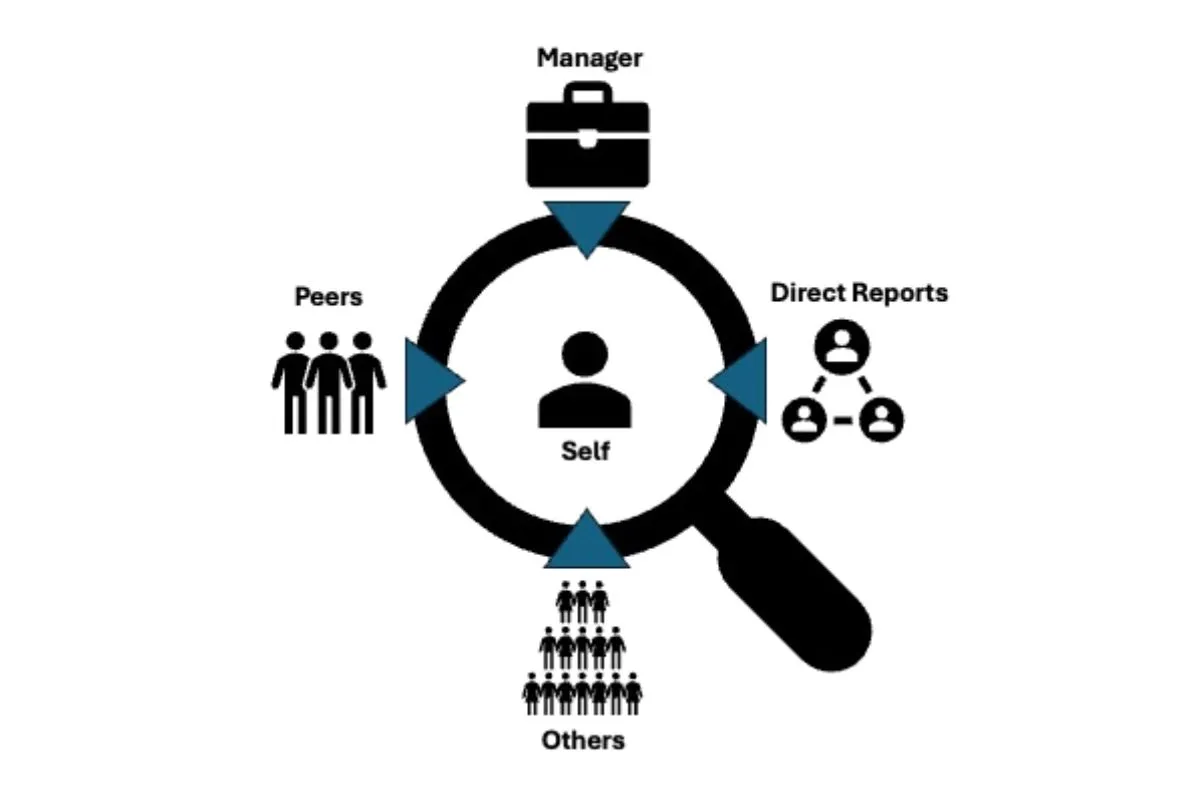
What is a 360 Survey?
It, therefore, shifts the focus from “How do I think I’m doing” to “To what extent am I demonstrating the behaviours that enable our desired leadership culture?”.
Why 360 Surveys Matter in Leadership Development
Heightened Self-Awareness
Self-awareness is the foundation of high-performance leadership. Research by Tasha Eurich (2018) highlights that while many leaders believe they are self-aware, far fewer truly understand how others experience them.
A 360 survey provides an objective "reality check" by highlighting the difference between a leader’s intent and their actual impact on the organisation.
Identifies Critical Blind Spots: It reveals behaviours—both strengths and weaknesses—that are visible to the team but hidden from the leader. Addressing these "blind spots" is often the fastest way to improve leadership effectiveness. When leaders understand their behavioural impact, development becomes intentional rather than reactive.
Aligns Perception with Reality: By comparing "Self" ratings against "Others”, leaders can see exactly where their self-perception is misaligned with the company’s experience of them.
Focuses Development ROI: Rather than guessing where to improve, leaders get a data-driven map of their most impactful growth areas. This ensures that time and resources spent on coaching or training are targeted for maximum return.
The Bottom Line: You cannot manage what you do not measure. By making the 'intangibles' of leadership measurable, 360 surveys turn subjective self-reflection into an actionable development strategy.
2. Balanced and Credible Feedback
Feedback from multiple sources carries greater credibility than a single manager’s opinion. According to David W. Bracken and Allan H. Church (2013), multi-rater feedback systems are most effective when aligned with strategic objectives and embedded within broader development systems.
Feedback from various touchpoints carries more weight and is harder to dismiss than a single point of view.
Mitigates Individual Bias: By aggregating views from peers, reports, and managers, the process filters out personal "blind spots" and individual biases (like favouritism or personality clashes), leading to a more objective performance profile.
Validates the "How”, not just the "What": While managers focus on results, direct reports and peers provide critical data on how those results are achieved—highlighting the leader's impact on culture, collaboration, and team morale.
Increases Buy-in and Accountability: When a leader sees consistent themes across different departments and levels, they are more likely to accept the findings. This consensus creates a sense of urgency for behavioural change that a standard top-down review rarely achieves.
The Bottom Line: 360 surveys replace subjective, single-manager opinions with an objective performance audit that is much harder for leaders to dismiss. By aggregating data from all organisational levels, the process eliminates individual bias and creates a clear, data-driven mandate for behavioural change.
3. Clear Development Priorities Linked to Culture
Leadership development often fails when it lacks focus. Research by Marshall Goldsmith (2006) demonstrates that feedback combined with follow-up significantly increases sustained behavioural change.
A behaviourally anchored 360 survey serves as a strategic filter, moving leaders from "general improvement" to targeted behavioural ROI.
Identifies High-Impact Behaviours: It isolates 2–3 critical cultural drivers—such as psychological safety or decision-making speed—ensuring the leader focuses only on the actions that will move the needle for the business.
Distinguishes Strengths from Risks: By clearly separating strengths to be leveraged from risks to be mitigated, the tool provides a blueprint for efficient resource allocation in personal development.
Connects Daily Actions to Strategic Outcomes: It anchors everyday management tasks to broader organisational goals, ensuring that individual growth directly supports the company’s current strategic roadmap.
The Bottom Line: Leadership development is only as effective as its focus; 360 surveys strip away the noise to identify the few critical behaviours that drive organisational culture. By linking these behaviours to clear strategic outcomes, individuals transform vague personal growth goals into a disciplined, high-impact execution plan.
Measuring the Behaviours That Shape Culture
Organisational culture is shaped by the behaviours leaders demonstrate consistently. If an organisation aspires to a culture characterised by clear direction, collaboration, and trust, these values must be transformed into tangible, verifiable behaviours.
For Example:
Creating direction by articulating a clear vision and purpose for teams and the organisation.
Fostering collaboration by creating a connected and inclusive environment where teams can thrive.
Building trust by empowering others, delegating effectively, and letting go of unnecessary control.
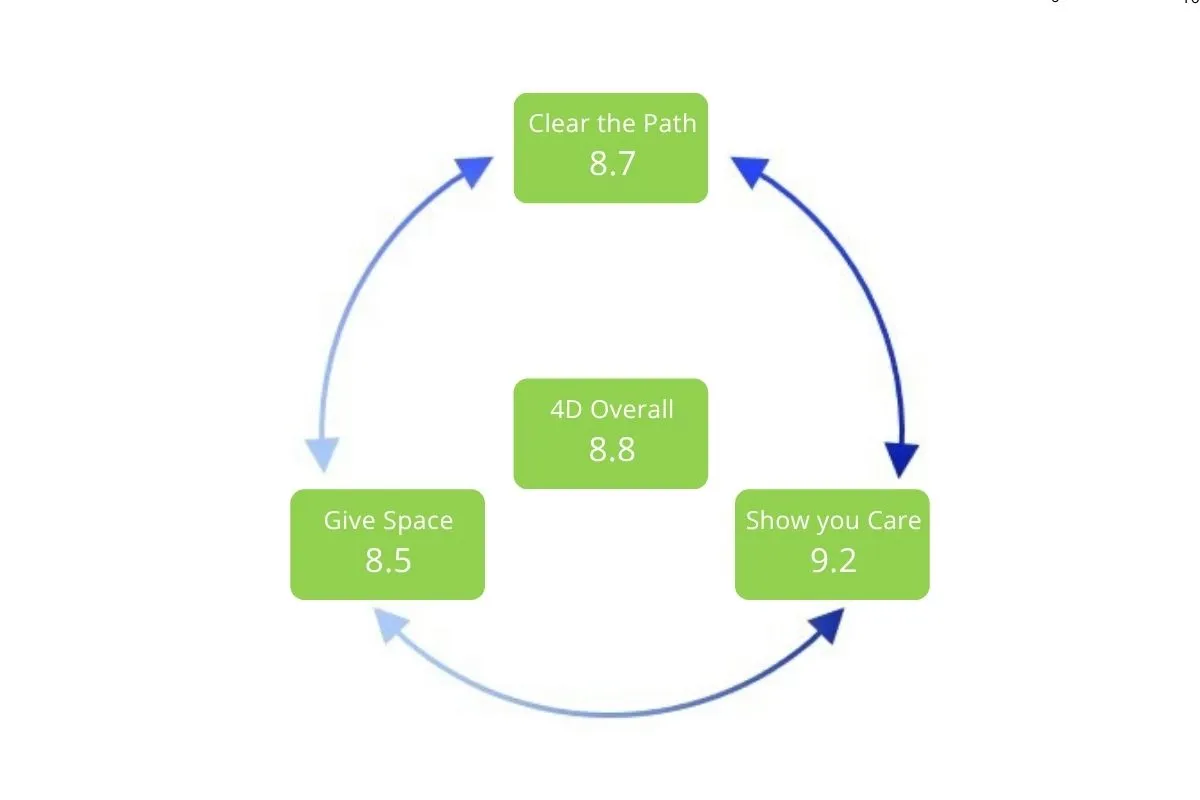
A well-designed 360 survey can evaluate these behaviours directly, creating a clear link between individual leadership development and broader cultural transformation.
Connecting Behavioural Change to Strategic Outcomes
Leadership culture is not shaped by intention alone; it is defined by the consistent behaviours of those in leadership positions. As Edgar Schein (2010) emphasises, leaders are primary architects of organisational culture. What they consistently do defines norms.
By anchoring daily management tasks to the organisation's strategic roadmap, leaders can move beyond vague improvement goals toward a disciplined, high-impact execution plan. When a 360 survey is aligned with an organisation’s leadership framework, it bridges the gap between individual growth and broader cultural transformation.
David W. Bracken and Allan H. Church (2013) found that organisations using well-designed 360 feedback systems reported improved leadership capability, stronger accountability, and more targeted development planning.
Thus, in summary when implemented at scale and analysed strategically, 360 surveys:
Accelerate individual self-awareness
Reinforce defined leadership standards
Identify systemic cultural barriers
Inform organisational process improvements
Strengthen alignment between behaviour and strategy
What Makes Our 360 Model Different?
If you’re serious about developing leaders who deliver real impact, your feedback tools need to go beyond opinions — they need to measure behaviour.
Behaviour, not just perception
Our 360-degree surveys are fully customisable to your organisation’s leadership framework, allowing you to assess the specific behaviours that drive your desired culture and performance outcomes.
Frequency and Effectiveness
We measure not just what leaders do, but how often they do it (frequency) and how well they do it (effectiveness).
Deeper insight into impact
This dual lens provides deeper, more actionable insight — highlighting whether a behaviour is
- underutilised,
- overused,
- or not landing effectively.
The results?
Clearer development priorities, more meaningful conversations, and targeted leadership growth. Combined with robust reporting and organisational trends analysis, our 360 surveys don’t just develop individuals — they give you the data to strengthen leadership capability across your entire organisation.
Connect with us:
At JVR Consulting, we work alongside you to either enhance your existing feedback processes or design bespoke 360-degree surveys from the ground up. We create assessment tools that are practical, role-relevant, and designed to provide a truly holistic view of leadership and performance.
So, if you want to provide your people with the meaningful, multi-dimensional feedback they need to grow, get in touch to find out how we can create custom 360-degree surveys for your team.
References
Bracken, D. W., & Church, A. H. (2013). The “new” performance management paradigm: Capitalizing on the unrealized potential of 360-degree feedback. People & Strategy, 36(2), 34–40.
Emam, S. M., Fakhry, S. F., & Abdrabou, H. M. (2024). Leaders’ development program by 360 degree feedback: reflection on head nurses’ leadership practices. BMC Nursing, 23. https://doi.org/10.1186/s12912-024-02395-w
Eurich, T. (2018). What self-awareness really is (and how to cultivate it). Harvard Business Review, 96(1), 114–122.
Geerts, J. M. (2024). Maximizing the impact and ROI of leadership development: A theory- and evidence-informed framework. Behavioral Sciences, 14(14), 955.
Goldsmith, M. (2006). Try feedforward instead of feedback. Leader to Leader, 2006(39), 11–15. https://doi.org/10.1002/ltl.166
Loignon, A., & Fleenor, J. (2025). Seeing leadership more clearly: Applying the Johari Window to enhance 360 leadership assessments. Center for Creative Leadership. https://doi.org/10.35613/ccl.2025.2058
Schein, E. H. (2010). Organizational culture and leadership (4th ed.). Jossey-Bass.
Share this post

Newsletter
Get up-to-date industry news right in your inbox